In 2024, the Special Investigation Service (STT) consistently pursued its mission – to reduce corruption in Lithuania, strengthen transparency in the public sector, and promote an anti-corruption culture within society and the business environment. Among the year’s key achievements were Lithuania’s improving ratings in international anti-corruption studies, an increasing share of convicted individuals in criminal cases investigated by the STT, a threefold increase in engagement with anti-corruption education activities, and a significantly enhanced capacity in analytical work and the assessment of identified corruption risks. These results reflect the Service’s professional, strategic, and results-driven approach to combating corruption and protecting national interests.
We observe positive trends in the international assessments of Lithuania’s anti-corruption environment – key indicators evaluating the country’s anti-corruption progress have improved: the Control of Corruption indicator increased from 76 to 78 points, and the Corruption Perceptions Index rose from 61 to 63 points. According to these assessments, Lithuania ranks 12th among European Union member states.
“The year 2024 clearly reflected the values upheld by the STT – professionalism, cooperation, and innovation. While criminal prosecution is an extreme measure, it remains an important area of the Service's work. Therefore, I highly value the fact that the percentage of convicted individuals in STT cases demonstrates the high quality and competence of our investigations. Another major achievement – not only for the Service, but for Lithuania as a whole – and one I consider among the most significant results of our cooperation, was the International Anti-Corruption Conference held in Vilnius, which brought together more than 2,200 experts from around the world. Meanwhile, innovative solutions applied across all areas of our activity enabled a significant expansion of anti-corruption education initiatives, strengthened the assessment of identified corruption risks, and contributed to the protection of national interests. Challenges were not lacking, but they only further strengthened the team that works every day with responsibility and dedication to the Homeland,” – STT’s Director Linas Pernavas said.
87% of Individuals Convicted in STT Cases in 2024
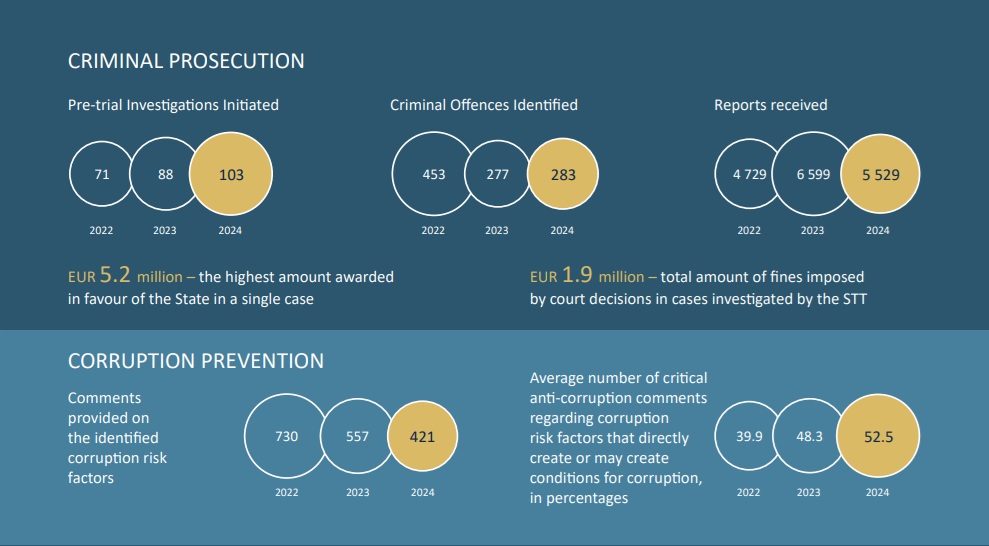
In 2024, the Service identified 283 criminal offenses and launched 103 pre-trial investigations. In cases where the pre-trial investigation was conducted by the STT, 86.8% of individuals were convicted by first-instance courts – an exceptionally high rate compared to previous years: 68.4% in 2022 and 65.3% in 2023.
Half of the Anti-Corruption Recommendations Provided by STT Were Classified as Critical
The corruption risk analyses conducted by the Service, along with its anti-corruption assessments of legislation and draft legal acts, significantly contribute to identifying and managing corruption risks and their contributing factors in legal regulations and the activities of public sector entities. Of the 421 comments submitted regarding potential corruption risks, 52.5% were classified as critical anti-corruption recommendations, addressing factors that could pose the highest corruption threats. The proportion of critical comments increased by 4% in 2024 compared to 2023.
The positive changes that followed the STT's anti-corruption recommendations span various fields. For example, the State Health Insurance Fund improved its control procedures and its system of measures for responding to unlawful use of budget funds. Positive changes were also made in the areas of construction, land-use designation and mode setting, and the allocation of funds in municipal road maintenance and development programs, among others.
To support public sector entities in fostering a corruption-resistant environment that encourages effective risk management, the Service updated its Guidelines for Creating a Corruption-Resistant Environment in the Public Sector.
Using Analytical Anti-Corruption Intelligence to Increase Public Sector Personnel Integrity and Protect National Interests
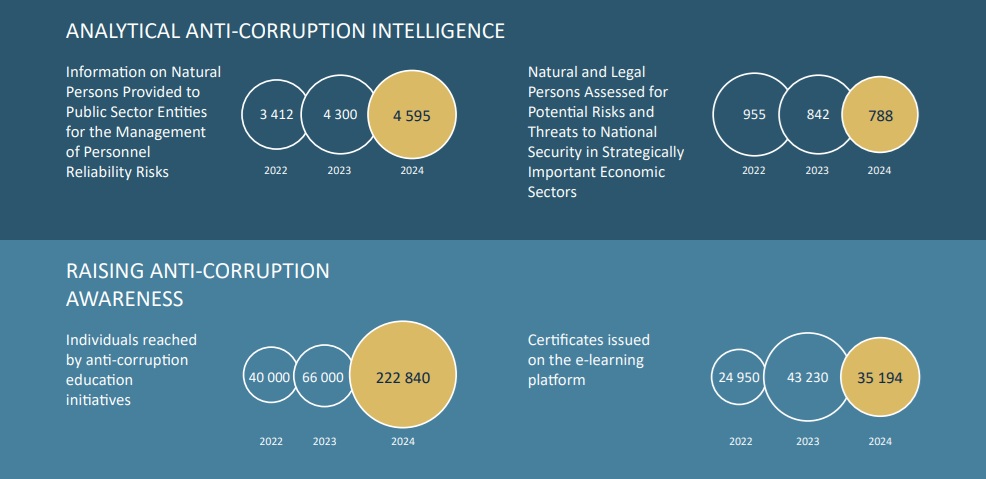
In 2024, the Special Investigation Service (STT) provided information on nearly 4,600 individuals to public sector entities to help manage risks related to personnel integrity. This is part of the Service's broader analytical anti-corruption intelligence activities, which also contribute to the protection of national interests in strategically important sectors of the economy.
In total, 788 individuals and legal entities seeking to invest or make transactions in the finance and credit, transportation, energy, and defense industries were assessed for potential risks in 2024.
STT Was Especially Active and Visible on the International Stage
The STT played a key role as the main organizer and coordinator in Lithuania of the 21st International Anti-Corruption Conference (IACC) – the largest global forum on this topic. Held in Vilnius from June 18–21, 2024, the event featured numerous plenary sessions and seminars and attracted over 2,200 participants from around the world.
In 2024, the STT also continued to chair the EPAC/EACN networks – the European Partners Against Corruption and the European Contact-Point Network Against Corruption. It actively participated in working groups of international organizations, strengthened bilateral relations, and implemented development cooperation and other international projects.
Anti-Corruption Education Initiatives Reached Over Three Times More People
To foster anti-corruption values in society, the STT continued to expand the reach of its awareness-raising initiatives, which grow in scope each year. In 2024, activities such as anti-corruption lectures and seminars, the STT e-learning platform, the youth social campaign “A Generation That Strives Independently”, the “Transparency Code” idea marathon, the national student competition, and more reached a total of 223,000 individuals – a 3.4-fold increase compared to 2023.
The Report is available here.