The investigation ‘2021 map of corruption in Lithuania‘, that was initiated by the Special Investigation Service (STT), showed decrease in the number of the residents, who are in favour of giving a bribe. The number of company managers, who view corruption as a very serious problem in developing business in Lithuania, has also halved. Although half of the Lithuanian population and nearly three-quarters of company managers know where to apply to report on corruption, only one of five residents and one of four company managers told that they would do that.
‘The latest data of the map of corruption in Lithuania show that evaluation of corruption, as a pressing issue, in Lithuania has not changed significantly in recent years. This could be a signal to the sectors which are constantly identified as the most corrupt that the time has come to take more resolute action in creating a corruption-resistant environment. We hope that the new Law on the Prevention of Corruption will encourage corporate leaders to include corruption prevention in the list of priority directions of activity, and this should be an integral part of good governance. We will be able to achieve a greater determination of society not to tolerate corruption and to get involved in anti-corruption initiatives only after anti-corruption values will be strengthened in every organisation’, - says Žydrūnas Bartkus, Director of the STT.
After low wages, rising prices and health problems, corruption is another most pressing issue
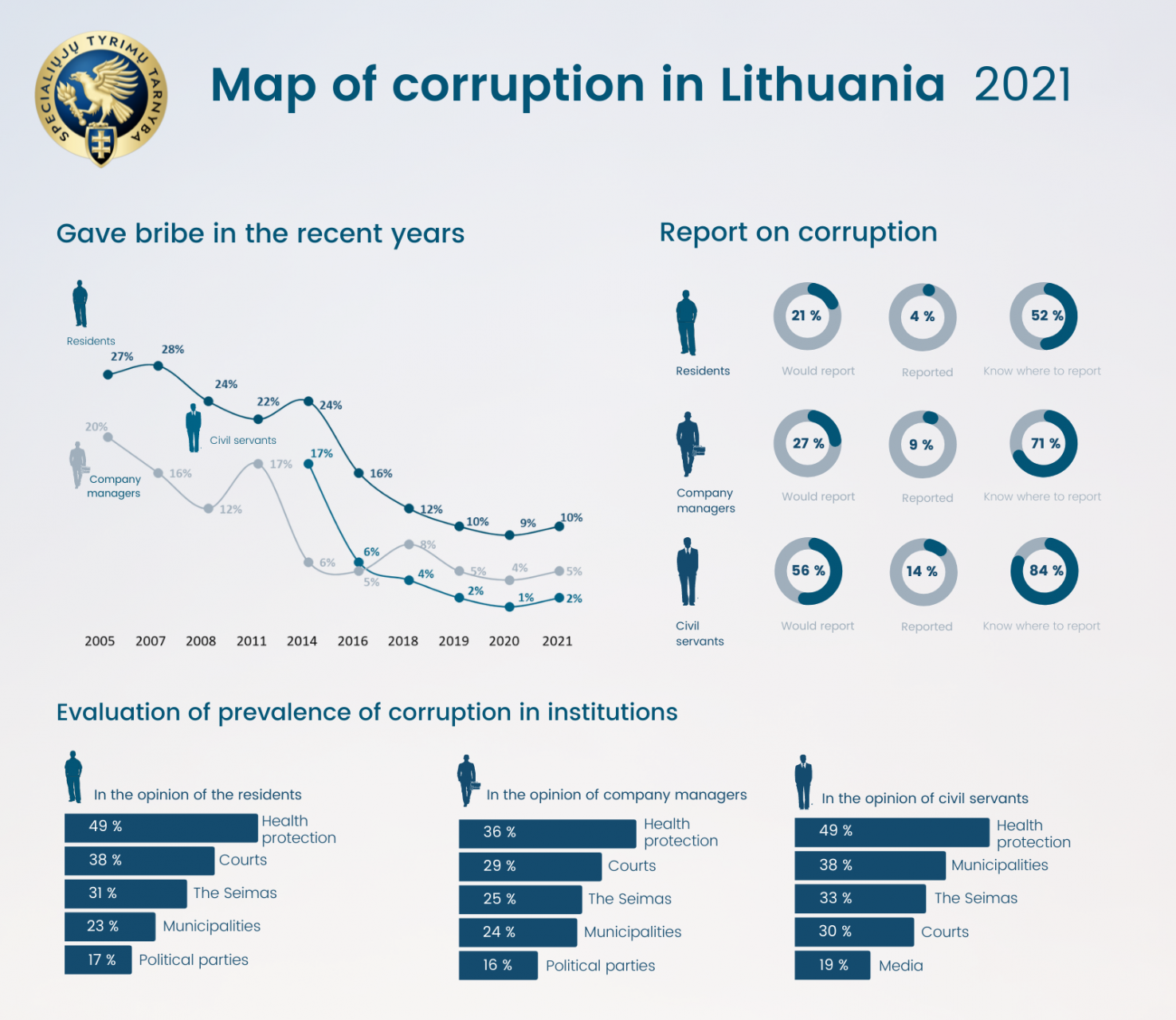
10 percent of the residents, 5 percent of company managers and 2 percent of civil servants stated that they had given a bribe in the last 12 months - compared to 2020, the situation has not changed significantly. After low wages, rising prices and health problems, corruption ranks 4th among the problems that are relevant to the Lithuanian population. Every third resident of Lithuania has pointed out corruption as a very serious problem. However, the number of company managers (in 2021 – 7 percent), who claim that corruption is a very serious problem in carrying out activities in Lithuania, has even halved.
The health sector remains the area in which risk of bribe extortion and giving a bribe is the most often encountered by the residents. Increase in corruption experience has also been observed in recent years. In the opinion of the residents and company managers, in 2021, medical institutions, courts, the Seimas, municipalities, and political parties are the most corrupt institutions. According to civil servants, the media also ranks in the top five of the most corrupt institutions. The media is rated worse than political parties and its evaluation is deteriorating for the second year in a row.
Systemic corruption is considered to be the main form of corruption in Lithuania in all target groups. Nepotism, patronage of members of political parties, delays in decision-making and the adoption of favourable laws that benefit individual groups are identified as the most relevant forms of corruption.
Deterioration in the evaluation of the level of corruption in the energy sector is observed
The residents and civil servants consider the Ministry of Health, the Ministry of Energy and the Ministry of Agriculture and their subordinate institutions as the most corrupt. The Ministry of Health, the Ministry of Energy and the Ministry of Agriculture and their subordinate institutions have been rated worst among company managers. The evaluation of the energy sector has deteriorated most of all ministries.
More civil servants consider decision-making in Lithuania to be open
In 2021, decision-making in Lithuania is considered to be open by 10 percent of the residents and company managers, and by 31 percent of civil servants. Improving evaluations of decision-making by civil servants are observed, which, compared to 2020, have increased one and a half times (was 21 percent).
In the opinion of civil servants and company managers, influence is usually sought to be made in the pharmaceutical, energy and health sectors. In 2021, the evaluation of the energy sector, as the sector that is most sought to be influenced, has greatly increased - 60 percent of civil servants and 62 percent of company managers think so.
Informal meetings and proposals, exploitation of connections, support for political campaigns or parties, the promise of a financial reward for a favourable decision - these were the most commonly named ways in which influence is sought to be made.
Only every seventh civil servant, who has faced corruption, has reported on it
The number of the residents, who say that a bribe helps solve problems, has decreased 6 percent over the year. However, their share remains high enough (65 percent). The anti-corruption potential remains one of the key challenges.
This is also shown by the proportion of the society willing to report on corruption. Although half of the population and almost three-quarters of company managers know where to report on corruption, only one out of five residents and only one out of four company managers states that they would do so.
Most civil servants (84 percent) know where to report on corruption, and the real anti-corruption potential has declined: as in 2020, every second civil servant would report on corruption. But, as was stated by the civil servants who have faced corruption, corruption was reported by one of seven civil servants (in 2020, one of five civil servants have stated to have reported on corruption).
Fear of having problems, disbelief that individuals will be convicted, the belief that everyone knows about corruption but does not report it, or lack of knowledge that prevents corruption from being recognised remained in 2021 as the main reasons for not reporting on corruption.
The investigation ‘2021 map of corruption in Lithuania’, that was initiated by the Special Investigation Service, has been performed by Public Opinion and Market Research Centre VILMORUS in September-November 2021. A total of 1,005 Lithuanian residents, 503 company managers and 697 civil servants were interviewed.
Detailed information of the investigation ‘2021 map of corruption in Lithuania’ is available here.